Grotta Island Lighthouse marks the outer point of Seltjarnarnes, at the western edge of the Reykjavík area. The first lighthouse went up in 1897 and the present one in 1947. It stands on Grotta, a tied island: at high tide the sea covers the spit that joins it to the shore, and low tide opens a window of about six hours to walk across. The island has been a nature reserve since 1974, and around 450 pairs of arctic terns nest there. Most visitors stay on the shore path for the views.
Grotta Island Lighthouse
Local name: Gróttuviti
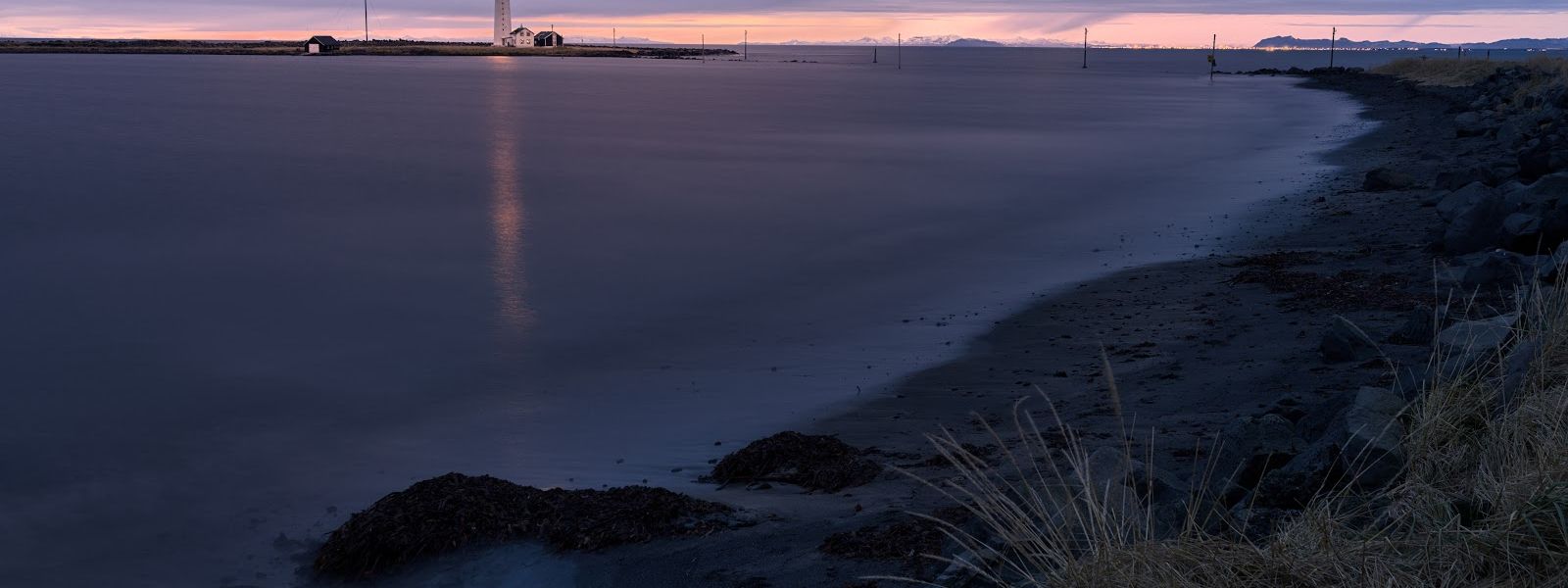
Twice a day the sea closes over the sandspit and leaves the lighthouse standing on an island.
- Accessibility
- Wheelchair-accessible car park and entrance; the shore paths are wide and level.
- Parking
- Free asphalt car park at Grotta, about 500 m from the lighthouse; wheelchair-accessible spaces.
- Difficulty
- Easy. Short, flat walking on wide paths; the only real obstacle is the tidal spit out to the island.
- Transport
- Nearest bus stops Hofgarðar and Hæðarbraut, about 1.3 km away — roughly 20 minutes on foot.
- Address
- Grótta, 170 Seltjarnarnes
What makes it special
The lighthouse sits at the far end of a low sandspit, and for much of the day it cannot be reached at all. At high tide the sea covers the spit and Grotta becomes an island. At low tide about six hours open up to walk over and back.
Most people never cross, and the shore path is enough. It is wide, flat and open, with Reykjavík across the bay on one side and mountains on the horizon. The island has been a nature reserve since 1974, and the birdlife is a draw in its own right. On dark, clear nights people drive out from the city to watch for the aurora.
Good to know
- Nesting season: the island is a nature reserve and closed to visitors from 1 May to 15 July, when about 450 pairs of arctic terns breed there.
- Northern lights: walk a few minutes out from the car park first. Headlights from parked cars wash out the dark sky.
- Birds: an information board on the birds of Seltjarnarnes stands near the car park, before you reach the shore.
- Food: the nearest restaurant, doing pizza and coffee, is back along the road in Seltjarnarnes.
Getting there
Most people drive out to the point. The car park is a short walk from the lighthouse, and the path from it is level and wide. From the nearest bus stop it is about 20 minutes on foot. Reaching the lighthouse itself is another matter: it stands beyond the spit, which is walkable only at low tide. Google Maps shows a route across it whatever the water is doing.
Best time to visit
Best: low tide, if you want to walk out to the island, and dark clear evenings from autumn to spring for the aurora.
Avoid: early summer, when the reserve is shut for the nesting season.
The point faces west over open water, so the sun sets out to sea beyond the lighthouse and the light comes off the water rather than from behind you.
Sun & daylight
Nearby Places


Similar Places


Featured in our guides
Grotta Island Lighthouse on the map
The spit floods as the tide comes in. Anyone still on the island then has to wait for the water to drop, and that takes hours. Check the tide before you cross, and count the time for the walk back.
Get directions

Your whole travel map in one place
Get inspired by new places around the world and find the ones worth the journey
Frequently asked questions
Can you walk out to the lighthouse?
Only at low tide. The spit joining Grotta to the shore is completely submerged at high tide, and low water leaves a window of about six hours. Google Maps shows a route across it regardless of the tide.When was the lighthouse built?
The first lighthouse on Grotta dates from 1897. The present one replaced it in 1947.Is Grotta good for the northern lights?
It is one of the spots people head to from Reykjavík. Walk away from the car park before you settle in, because car headlights spoil the view.Is there anything to see apart from the lighthouse?
Views across the bay to Reykjavík and out to the mountains, and birds: the island is a nature reserve with a large arctic tern colony. An information board near the car park covers the birds of Seltjarnarnes.Are the buildings by the lighthouse open?
No. The main house has stood empty since 1970. The municipality bought the buildings in 1994, and they are now used occasionally by school groups.