Geysir is a geyser in the Haukadalur valley in South Iceland, on the slopes of the Laugarfjall lava dome. Every geyser in the world is named after it. The modern geyser formed around 1150 CE, though hot springs have been active on the site for roughly 10,000 years. Eruptions can throw boiling water up to 60 metres, but they are now infrequent. The geothermal field around it holds around thirty smaller geysers and hot pools, including Strokkur, and is one of the three main stops on the Golden Circle with Þingvellir and Gullfoss.
Geysir
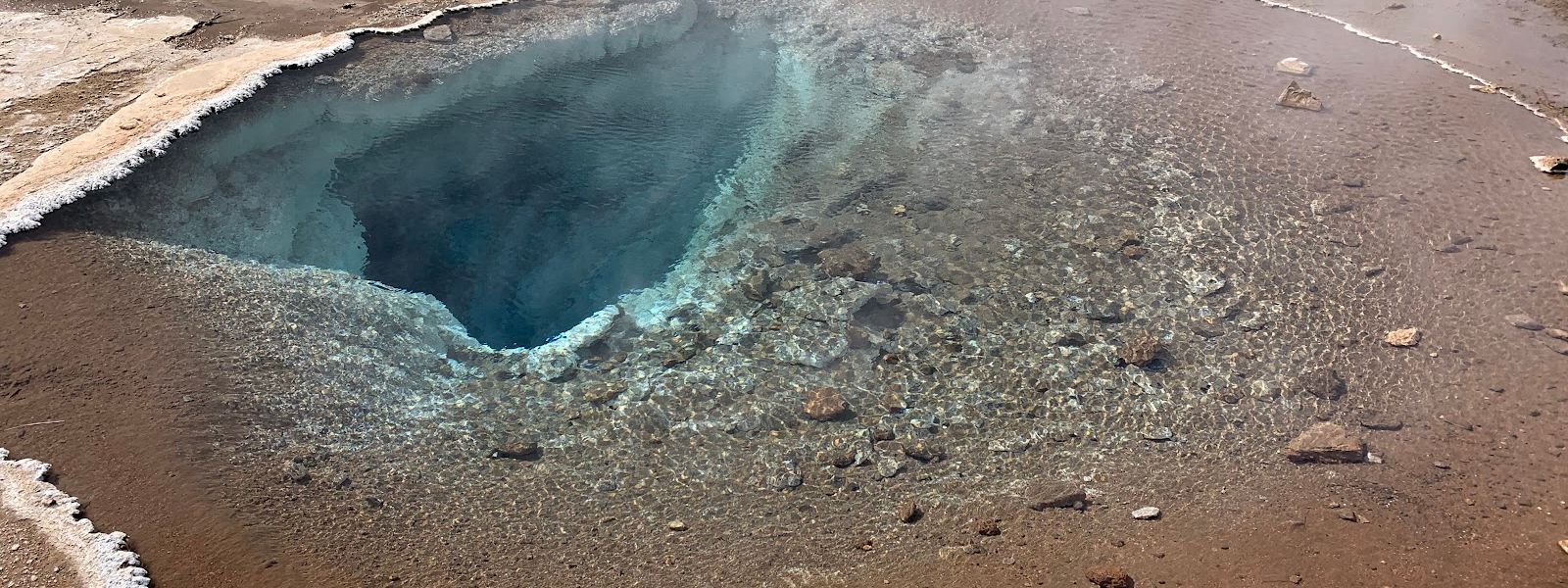
Every geyser on Earth is named after this one — the word comes from the Icelandic verb geysa, "to go quickly forward".
- Entrance
- Free
- Parking
- Large car park at the site.
- Difficulty
- Walkways through the geothermal field; a footpath climbs the hill above it to a view over the valley.
- Transport
- Self-drive — Golden Circle (Route 35)
- Address
- Geysir, 806
What makes it special
Geysir gave English the word geyser, from the Icelandic verb geysa, "to go quickly forward". It is also the one thing in the valley that hardly ever performs. Eruptions at Geysir are infrequent now, and in the past they have stopped altogether for years at a time. The geyser in most of the photographs is Strokkur, about 50 metres to the south, which throws water up to 35 metres every few minutes. Around thirty smaller geysers and hot pools lie in the same field, including Litli Geysir, and thermal mapping has counted 364 separate hot areas. The whole place smells of sulphur.
Good to know
- Geysir itself rarely erupts. Its eruptions have stopped for years at a time. Strokkur, 50 metres south, is the one that goes off every few minutes.
- The water is at boiling point. Geysir's conduit runs at 85–95 °C near the top and about 120 °C deeper down. Stay on the walkways.
- The field smells of sulphur. The smell comes from the geothermal water and is part of the visit.
- There is a large car park, a coffee house, a restaurant and a souvenir shop.
- A footpath climbs the hill above the field to a view over the valley.
Getting there
Geysir lies in the Haukadalur valley in South Iceland, on the Golden Circle route with Þingvellir and Gullfoss, and most people arrive by car or on a coach tour. There is a large car park at the site. From there, walkways run out into the geothermal field; Strokkur is about 50 metres south of the Geysir vent, so both are reached on the same circuit. A footpath climbs the hill above the field to a view over the valley.
Best time to visit
Better: a summer evening. Setting out around 20:00 leaves the field almost empty, and in Icelandic summer there is still full daylight.
Avoid: building the visit around Geysir itself. It erupts rarely, and time spent waiting for it is time not spent on Strokkur, which goes off every few minutes.
Geysir is a fixed stop on the Golden Circle and coach groups call here, so the walkways are busiest when the tours are running.
Sun & daylight
Nearby Places

Similar Places
Featured in our guides
Geysir on the map
The water in the vents and pools is at boiling point. Geysir throws it up to 60 metres, Strokkur up to 35 metres, and the spray drifts on the wind. Keep to the walkways and keep children back from the edges of the pools.
Get directions

Your whole travel map in one place
Get inspired by new places around the world and find the ones worth the journey
Frequently asked questions
Does Geysir still erupt?
Rarely. Eruptions are infrequent and have stopped for years at a time; a large eruption in 2016 was treated as news. The geyser that erupts every few minutes is Strokkur, about 50 metres to the south.How high does Geysir go?
Eruptions typically hurl boiling water up to 60 metres. After the earthquakes of 2000 it reached 122 metres for two days, one of the highest geysers ever recorded. In 1845 it was measured at 170 metres.How old is the geyser?
Sinter deposits date the modern geyser to about 1150 CE. Hot springs have been active at the site for roughly 10,000 years, and the geothermal heat comes from the Haukadalur volcanic system, which has not erupted in over 10,000 years.Is Geysir part of the Golden Circle?
Yes. Together with Þingvellir and Gullfoss it forms the Golden Circle, the best-known tourist route in Iceland.Who owns the site?
The Icelandic people. Local farmers sold the area in 1894 to James Craig, who fenced it and charged admission; the fees were dropped the following year. In 1935 the site was bought by the film director Sigurður Jónasson, who gave it to the nation in perpetuity. Full public ownership of the access routes followed in 2017.