Höfði House stands alone on the seafront in Reykjavík, in the Laugardalur district. It was prefabricated in Norway and erected in 1909 for the French consul, and was then the largest private residence in the city. The poet Einar Benediktsson lived here from 1913 to 1925, and the British Embassy used the house in the 1940s and 1950s. In 1986 it hosted the Reykjavík Summit between Ronald Reagan and Mikhail Gorbachev. The City of Reykjavík has owned it since 1958 and holds official receptions here, so visitors see it from the outside.
Höfði House
Local name: Höfði
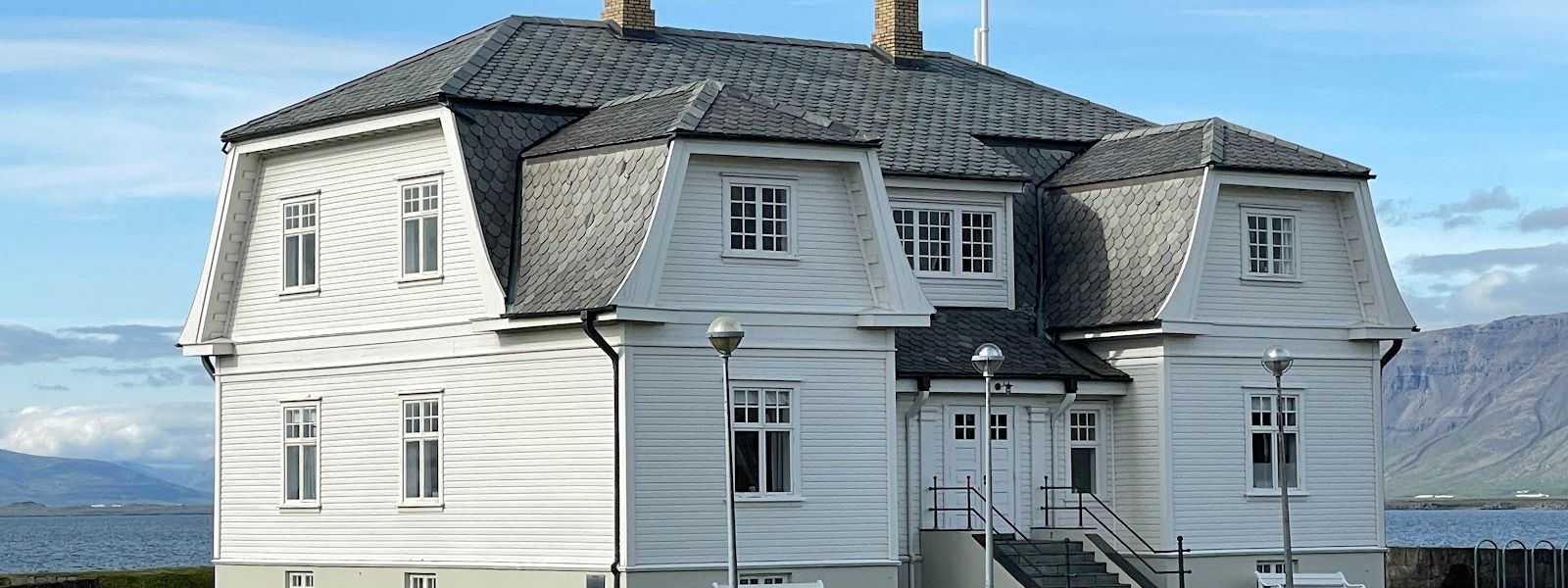
Asked whether the house is haunted, the Icelandic Foreign Ministry answered officially: "We do not confirm or deny that the Höfði has a ghost."
- Entrance
- Free (exterior & grounds; interior closed)
- Accessibility
- Wheelchair-accessible parking and a wheelchair-accessible entrance.
- Parking
- Parking area beside the house, in paid zone P3, charged 9:00–18:00 on weekdays.
- Transport
- 20-min waterfront walk east from the centre
- Address
- Félagstún 1, 105 Reykjavík
What makes it special
The doors are shut. Höfði House belongs to the City of Reykjavík and is used for official receptions, so a visit means walking up to the walls and around them. The house stands by itself on open ground above the shore, with nothing between it and the sea, and the view runs across the harbour to the mountains. Information boards on the lawn tell the story of 1986, when Ronald Reagan and Mikhail Gorbachev met here. The talks ended without an agreement and still pushed the Cold War towards its end. A fragment of the Berlin Wall stands on the grounds. Inside, out of sight, the flags of the United States and the Soviet Union hang crossed to mark the meeting. The house caught fire on its hundredth birthday, 25 September 2009; everything irreplaceable was carried out.
Good to know
- The house is closed to visitors — it belongs to the City of Reykjavík and is used for official receptions, not opened for tours.
- Everything happens outdoors — the visit is a walk around the building and its lawn, with nowhere indoors to step out of the rain.
- The signs are selective — the boards cover the summit and the building; the ghost stories are not on them.
Getting there
Höfði House stands on the shore in the Laugardalur district of Reykjavík. Most visitors arrive by car: there is a parking area beside the house, and from it you walk across open lawn to the walls. You can go right up to the building and all the way around it. The information boards stand outside, on the grass.
Best time to visit
Better: clear weather, when the view from the lawn runs over the harbour to the mountains — in June they still carry patches of snow.
Avoid: arriving on the assumption that you can get in. The house is closed and the whole visit is outdoors.
The site is open ground by the sea with no shelter, so the weather counts for more here than the hour of the day.
Sun & daylight
Nearby Places

Similar Places



Your whole travel map in one place
Get inspired by new places around the world and find the ones worth the journey
Frequently asked questions
Can you go inside Höfði House?
No. The house belongs to the City of Reykjavík and is used for official receptions and events. You can walk right up to it and all the way around the outside, where information boards cover its history.What happened at Höfði House in 1986?
Ronald Reagan and Mikhail Gorbachev met here for the Reykjavík Summit. It produced no agreement, but it was an important step towards the end of the Cold War. Inside the house, the flags of the United States and the Soviet Union are hung crossed to commemorate the meeting.Is Höfði House haunted?
The story is old. The memoirs of an early occupant describe the spirit of a young woman, and local legend calls the site a Viking burial ground. In 1952 John Greenway, then living in the house, asked the Foreign Office for permission to move the British consulate out because of bumps in the night. The house was sold back to the Icelandic government that same year.What else is there to see on the grounds?
A fragment of the Berlin Wall, the information boards, and a statue of the poet Einar Benediktsson by Ásmundur Sveinsson, moved next to the house in 2015. The site also carries a piece of communications history: the first radio contact between Iceland and the outside world was made here in 1905, with Poldhu in Cornwall.