Þúfa is a work of art on the Reykjavík harbour front, made by the artist Ólöf Nordal and finished in December 2013. It is an artificial mound with a single spiral path climbing to the top, where a traditional hut for drying fish stands. The mound is smaller than many people expect, and the climb is quick. The draw is the view from the top: across the harbour to the city, out to the mountains in the distance, and along the shore to the yellow lighthouses. It stands outside the city centre.
Þúfa
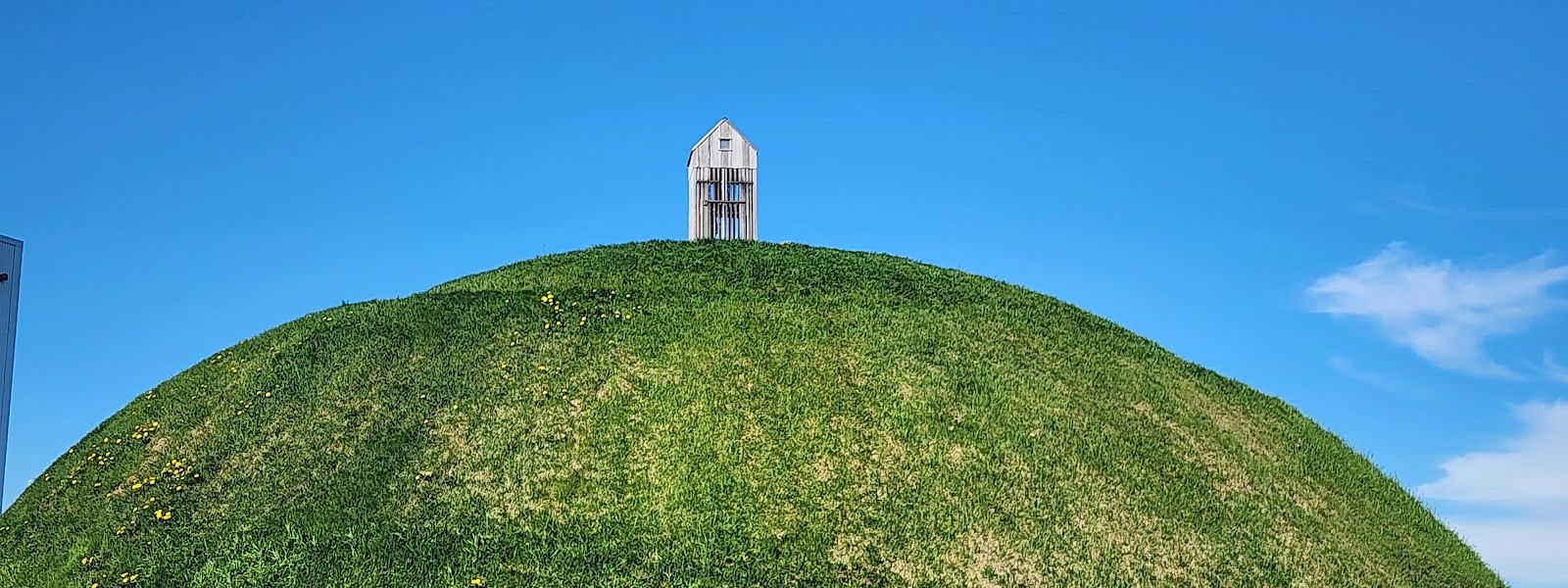
Ólöf Nordal finished Þúfa in December 2013: an artificial mound with a spiral path to a traditional fish-drying hut on top.
- Entrance
- Free, no ticket.
- Accessibility
- The entrance is not wheelchair accessible.
- Parking
- Free car park nearby, plus free street parking.
- Difficulty
- One spiral path of bare rock, one person wide, with no railing; the climb to the top is quick.
- Transport
- A city bus route runs this way.
- Hours
- Open 24 hours, every day.
- Address
- Norðurslóð, Grandi, 101 Reykjavík
What makes it special
From the waterfront Þúfa reads as a green hill until you notice the path. A single spiral track winds round the mound to the top, where a traditional wooden hut for drying fish stands. Ólöf Nordal made it as a work of art, and the walk up is part of the work. The mound is smaller than many people picture, and the climb is quick. What holds people at the top is the view: across the harbour to the city, out to the mountains in the distance, and along the shore to the yellow lighthouses. The path takes one person at a time, so the top never fills.
Good to know
- Toilets: none on site.
- The path: bare rock, one person wide, with no railing. Two people cannot pass on it comfortably.
- Wheelchairs: the entrance is not wheelchair accessible.
- Children: the site suits children, but keep them beside you on the unrailed path.
Getting there
Þúfa stands outside the city centre, so walking out to it takes a while. There is parking nearby, and a city bus route runs this way. From the waterfront, approach along the public path by the water. The dockyard facing the old harbour is private and in use, so do not cut through it. At the mound itself a single spiral path climbs to the hut at the top.
Best time to visit
Better: a clear day. The climb is quick and the reward is the view — across the harbour to the city, and out to the mountains in the distance. Low cloud takes all of it away.
Avoid: busy moments. The spiral path takes one person at a time, and meeting someone coming down means one of you steps off the rock.
Sun & daylight
Nearby Places



Similar Places


Þúfa on the map
The spiral path is bare rock, one person wide, and has no railing. Passing another walker means stepping off the edge, so let people come down before you start up.
Get directions

Your whole travel map in one place
Get inspired by new places around the world and find the ones worth the journey
Frequently asked questions
What is at the top of Þúfa?
A traditional hut for drying fish. From beside it the view runs across the harbour to the city, out to the mountains in the distance, and along the shore to the yellow lighthouses.Who made Þúfa, and when?
The artist Ólöf Nordal. The mound was finished in December 2013.Are there toilets at Þúfa?
No. There are none on site.Is Þúfa wheelchair accessible?
No. The entrance is not wheelchair accessible, and the path to the top is bare rock without a railing.Is Þúfa suitable for children?
Yes. The path is one person wide and has no railing, so keep children beside you on the way up.