The Icelandic Phallological Museum is in Reykjavík and holds the world's largest display of penises and penile parts. Sigurður Hjartarson, a retired teacher, began collecting in 1974 and opened the museum in 1997; his son Hjörtur Gísli Sigurðsson runs it now. The specimens come from Icelandic land and sea mammals — whales, seals, farm animals — and are shown in formaldehyde jars or dried and mounted. A folklore section covers elves, trolls and kelpies. The museum draws over 70,000 visitors a year.
The Icelandic Phallological Museum
Local name: Hið íslenzka reðasafn
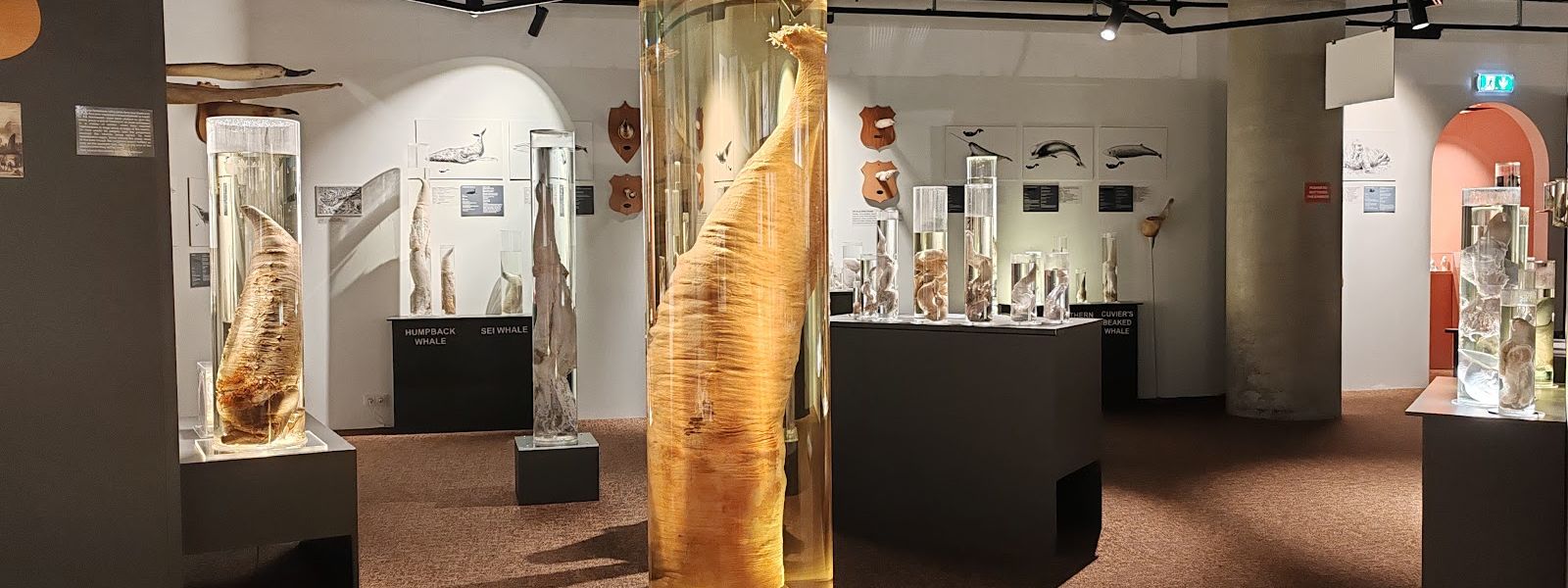
The largest exhibit is 170 cm of sperm whale penis weighing 70 kg; the smallest, a hamster's baculum at 2 mm, needs a magnifying glass.
- Entrance
- Paid
- Accessibility
- Wheelchair-accessible entrance, toilet, seating and parking are listed. The way in is also described as a flight of stairs, so contact the museum in advance if you cannot use stairs.
- Parking
- Paid car park.
- Transport
- Central 101 — walkable from downtown
- Hours
- Open daily, 10:00–19:00.
- Address
- Reykjastræti 4, 101 Reykjavík
What makes it special
The largest exhibit is the front tip of a sperm whale's penis: 170 cm long, 70 kg, and only a portion of the whole organ. The smallest is a hamster's baculum, 2 mm long, which needs a magnifying glass to see. Between the two sit specimens from Icelandic land and sea mammals, kept in formaldehyde jars or dried and mounted on the walls.
The collection does not stop at anatomy. A folklore section lists penises taken from elves, trolls and kelpies; since folklore holds those creatures to be invisible, there is nothing in the case to look at. Fifteen silvered sculptures stand for the Iceland men's handball team that won silver in Beijing in 2008. Lampshades are made from bulls' scrotums. A plaster cast of Jimi Hendrix's penis, made in 1968, went on show in 2022, and in December 2024 the museum added a cast of Matt Barr measuring over 36 cm.
Good to know
- Small, and relentlessly on-theme: the museum takes up little space and there is no break from the subject inside it.
- How long to allow: visits run from about half an hour to two hours, depending on how much of the labelling you read.
- Facilities: there are toilets on site, plus a bar, a café and a gift shop; the café menu includes gluten-free and vegan options.
Getting there
The museum is in Reykjavík, and the way in is up a flight of stairs. An accessible entrance and accessible parking are listed as well, so if stairs are a problem, contact the museum before you go and ask which way in to use.
Things to do nearby
All tours in Reykjavík on GetYourGuide
Paid links: booking through them supports YowJourney.
Sun & daylight
Nearby Places


Similar Places





Your whole travel map in one place
Get inspired by new places around the world and find the ones worth the journey
Frequently asked questions
Is there a human penis in the collection?
Yes. The museum received its first in 2011, from a 95-year-old Icelandic donor. The removal did not go to plan, and the specimen ended up a greyish-brown, shrivelled mass preserved in formalin.How long does a visit take?
Anywhere from about half an hour to two hours. The difference is how much of the labelling you read: the exhibits are captioned in detail, and much of the interest is in the text rather than the jars.Is there anywhere to eat or drink?
There is a bar and a café on site, with gluten-free and vegan options on the menu, and a gift shop.Has the museum always been in Reykjavík?
No. It moved to the fishing town of Húsavík in 2004, when the founder could no longer afford the rent on the Reykjavík premises, and returned to Reykjavík in 2012 under his son.Is there a film about the museum?
Yes. The Final Member, by Canadian documentary makers Zach Math and Jonah Bekhor, follows the search for a human penis for the collection. It premiered in May 2012.