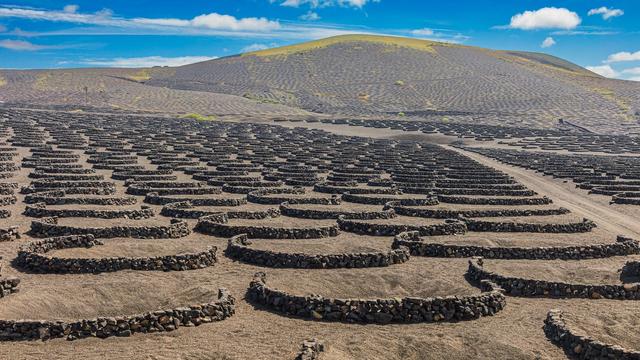
La Geria is a wine-growing area in the municipality of Yaiza on Lanzarote, part of the Lanzarote DO wine region and a protected area. Each vine is planted on its own in a pit 4–5 m wide and 2–3 m deep, with a low stone wall around it. The method catches rainfall and overnight dew and shields the plant from the wind on an island where little rain falls outside winter. The pits are dug into the volcanic ash laid down by the eruptions of 1730–1736.
La Geria Wine Region
Local name: La Geria
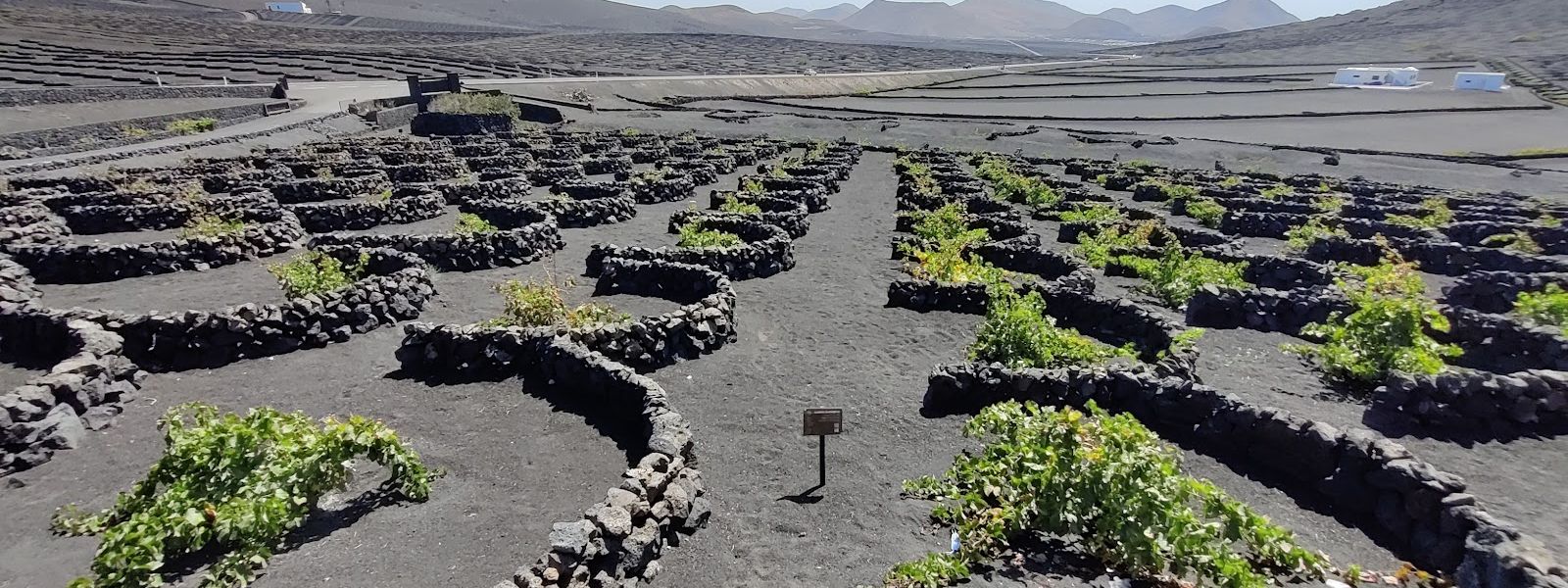
Protected vineyard landscape of single vines sunk in black-ash pits, each ringed by a low stone wall
- Entrance
- No ticket: the vineyard landscape is open countryside.
- Parking
- Two free car parks about 36 m and 75 m away; the second is unpaved.
- Difficulty
- None to speak of: free car parks sit close by and the vineyards are in view from there.
- Transport
- Nearest bus stop: La Asomada Centro, about 2.3 km away in a straight line.
- Hours
- The landscape is open at all times.
- Address
- 35570 La Geria, Las Palmas, Spain
What makes it special
Every vine at La Geria lives in its own hole. The pits are 4–5 m across and 2–3 m deep, enough to hide a standing adult, and each has a low wall of stacked stone around its rim. Seen from the road, they pock the black slopes one after another, a single vine at the bottom of each.
Nothing here is decoration. The pit reaches down to soil under the ash, the wall breaks the wind, and the hollow gathers what little rain falls and the dew that forms overnight. The ash came from the eruptions of 1730–1736, which buried the most fertile land on the island. The growers dug back down through it.
Good to know
- Two free car parks and free toilets sit close together.
- There is no drinking water nearby: fill up before you come.
- The ground between the pits is bare black ash with no shade. Bring a hat.
- Walkers' signposts stand about 200 m away, so the vineyards can be explored on foot as well as from the car.
Getting there
A car is the straightforward way in. Two free car parks lie close together, one of them unpaved, with free toilets beside them, and the pits start from there. Walkers' signposts stand about 160–200 m away for anyone who wants to go further among the vines on foot.
The nearest bus stop, La Asomada Centro, is about 2.3 km away in a straight line, which turns a bus trip into a long walk across open, shadeless ground.
Best time to visit
Best: early morning or late afternoon, from spring to the end of summer. Low sun throws shadow into the pits and picks out every wall, and the vines are in leaf through the warm months.
Avoid: midday in summer, and days when the sirocco blows. The black ash soaks up the heat with no shade anywhere between the pits, and the hot sirocco wind fills the air with dust that blurs the view across the slopes.
Access & restrictions
La Geria is a protected area, and the pits are working vineyards. Keep to the roads and tracks, stay out of the pits and off the stone walls: each wall is stacked by hand, and a dislodged stone opens a gap in the wind break. Leave the grapes and leaves on the vines.
Sun & daylight
Nearby Places
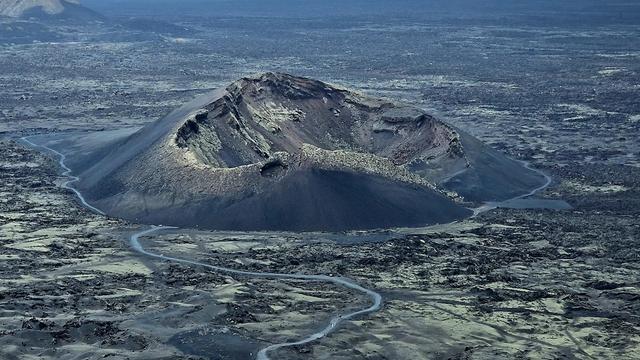
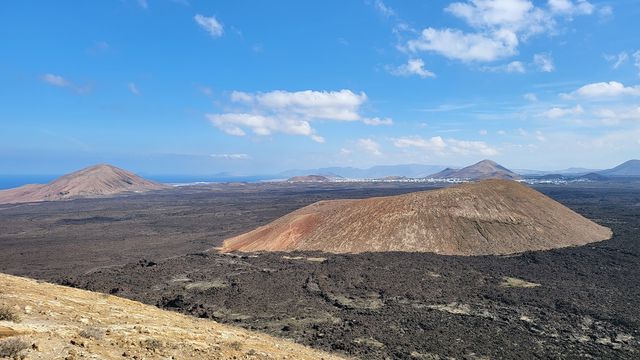
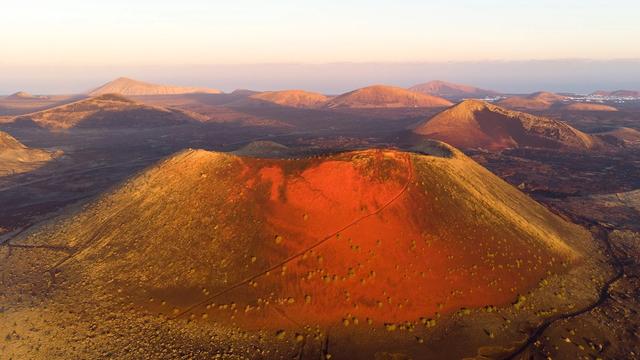
Similar Places
Featured in our guides

Your whole travel map in one place
Get inspired by new places around the world and find the ones worth the journey
Frequently asked questions
Why are the vines at La Geria planted in pits?
Each pit, 4–5 m wide and 2–3 m deep with a stone wall around it, collects rainfall and overnight dew and protects the vine from the wind.Is there parking at La Geria?
Yes. There are two free car parks close together, one of them unpaved.Can I get to La Geria by bus?
The nearest bus stop is La Asomada Centro, about 2.3 km away in a straight line. A car is the easier option.Are there toilets and water?
Free toilets stand near the car parks. There is no drinking water nearby, so bring your own.Which wine region is La Geria part of?
La Geria belongs to the Lanzarote DO wine region, and its vineyards are a protected area.