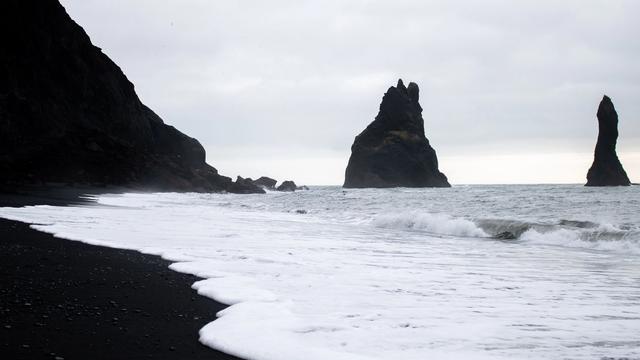
Diamond Beach is a black-sand shore on Breiðamerkursandur, a glacial outwash plain in the municipality of Hornafjörður, South Iceland. The plain was built over the last few centuries by the glaciers Breiðamerkurjökull, Fjallsjökull and Hrútárjökull, outlets of Vatnajökull. Ice breaking from the glacier drifts out of the Jökulsárlón lagoon to the sea and is washed back onto the sand, and those glittering fragments give the beach its name.
Diamond Beach
Local name: Breiðamerkursandur
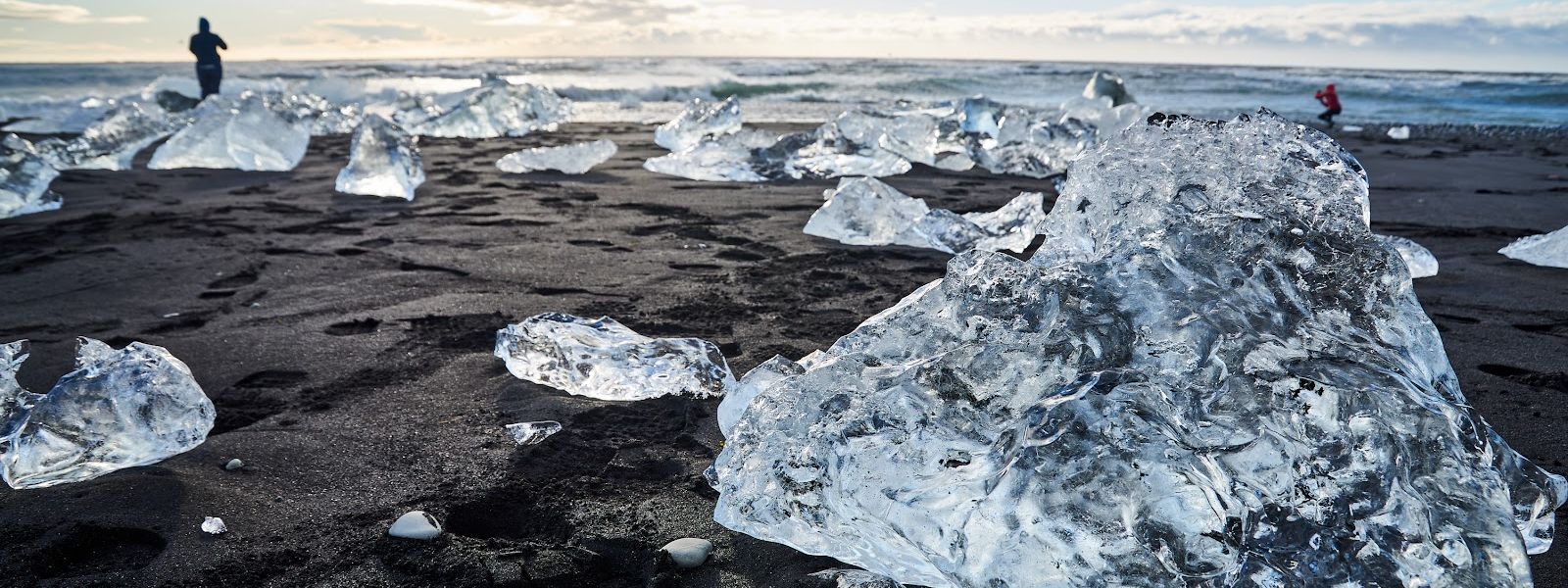
Glacier ice, some of it clear and some deep blue, washes up on black volcanic sand.
- Entrance
- No ticket for the beach; the car parks charge a fee.
- Parking
- Two paid asphalt car parks, about 100 m and 300 m from the beach.
- Difficulty
- No real walk in: the car parks sit behind the beach, and the ground is black sand and stranded ice.
- Transport
- Bus stop Jökulsárlón, about 415 m from the beach.
- Advance booking
- Not needed.
- Hours
- Open 24 hours, every day.
- Address
- Diamond Beach, 781, Iceland
What makes it special
Blocks of glacier ice lie stranded on black sand at the edge of the surf. Some are clear as glass, some a deep blue, others worn by the waves into rounded, sculpted shapes. The blue belongs to ice that was compacted hard inside the glacier, with the air squeezed out of it. Every piece has floated out of Jökulsárlón, and the sea keeps shifting them, so the beach looks different each day and no visit repeats the last.
Look past the ice at the water too. Seals swim close in, and seabirds work the waves for fish.
Good to know
- Nothing guarantees big ice: the sea sets down a different spread every day, from large blocks to scattered small pieces.
- Bring water with you. No drinking-water tap stands within 800 m of the beach.
- Free toilets are about 425 m from the beach.
Getting there
Diamond Beach is a drive-up stop. The car parks sit just behind the shore, and from the nearer one you are on black sand almost as soon as you leave the car. Arriving by bus, you get off at the stop named after the lagoon, Jökulsárlón, and cover the last stretch to the sea on foot. Information boards stand where the beach begins. The river draining the lagoon cuts the shore in two, with ice stranded on either side of its mouth.
Best time to visit
Best: around sunset, when low light catches the ice against the black sand.
Avoid: building a whole day around the ice alone.
The spread of ice changes daily, and one visitor on 20 June found only small fragments on a crowded shore, so the low evening sun is the one condition you can plan for.
Access & restrictions
Diamond Beach lies inside Vatnajökull National Park: in 2017 the park's borders were redrawn to take in Breiðamerkursandur, the plain the beach stands on, together with Jökulsárlón. The sandur is a breeding ground for birds, among them Arctic terns and great skuas, so keep well clear of nesting birds; both defend their nests by diving at people. As everywhere in Iceland, driving off roads and marked tracks is against the law.
Sun & daylight
Nearby Places


Similar Places


Featured in our guides
Diamond Beach on the map
The beach faces the open Atlantic and takes powerful breaking waves that can surge far up the sand without warning. Never turn your back on the sea. Stay off the ice: blocks shift and roll as the surf moves them, and a slip puts you in freezing water. The river channel from the lagoon runs with a strong current; do not wade it.
Get directions

Your whole travel map in one place
Get inspired by new places around the world and find the ones worth the journey
Frequently asked questions
Where does the ice on Diamond Beach come from?
It breaks off Breiðamerkurjökull into the Jökulsárlón lagoon, drifts out to sea through the lagoon's outlet and is washed back onto the black sand.Is there always ice on the beach?
The amount changes every day. Some days bring large clear and blue blocks; on others the shore holds only small pieces.Do you have to pay to park?
Yes. Both car parks near the beach charge a fee.Is Diamond Beach suitable for children?
Yes, with a firm hand near the water. Keep children back from the surf line and off the ice, which moves in the waves.