Kerid is a volcanic crater lake in the Grímsnes area of South Iceland, on the Golden Circle route. The crater is elliptical: about 270 metres across, 170 metres wide and 55 metres deep, with walls of basalt and scoria. An explosive eruption formed it between roughly 6,400 and 9,000 years ago. A shallow lake with aquamarine water lies at the bottom. A path runs around the rim, and steps lead down the one gently sloping side to the water.
Kerid Crater
Local name: Kerið
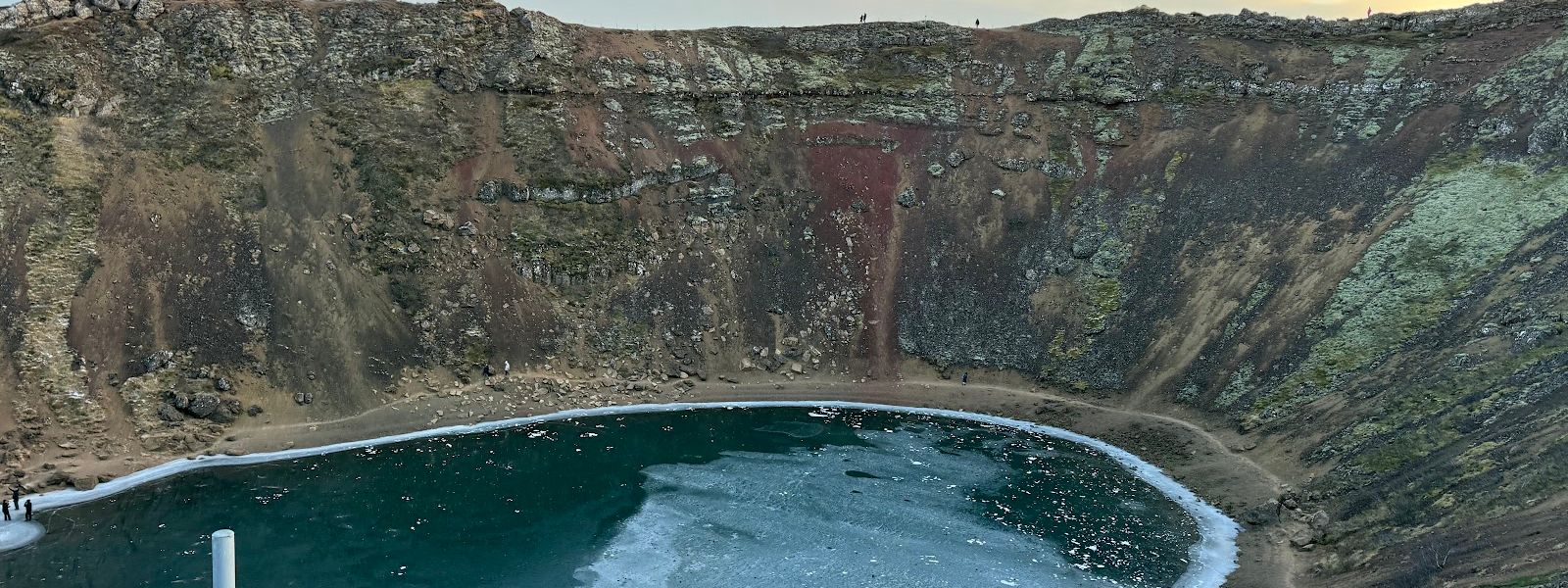
The lake at the bottom is only 6 to 14 metres deep, and its aquamarine colour comes from minerals in the soil, not from the sky.
- Entrance
- Ticketed: 700 ISK as of March 2026. The land has been privately owned since 2023. Cards and contactless are accepted.
- Accessibility
- Wheelchair-accessible car park and entrance. The main wooden platform gives a full view of the crater; the steps down to the lake are not accessible.
- Parking
- Free gravel car park at the entrance, about 90 metres from the crater. It fills up when tour coaches arrive.
- Difficulty
- Easy. The rim path is made up and level. The descent to the lake is on built steps down the one gently sloping wall, 55 metres each way.
- Transport
- No bus stop within 5 kilometres; visitors come by car or on a Golden Circle coach tour.
- Address
- 805 Klausturhólar
What makes it special
At Kerid you can look into the crater and also walk down into it. One wall slopes gently and is blanketed with deep moss, and built steps run down it to the lake at the bottom. The other walls are steep basalt and scoria, and the rock here is red rather than the black lava common elsewhere in Iceland. The lake is 6 to 14 metres deep, depending on the groundwater, and minerals in the soil give the water an aquamarine colour. Red rock, blue water and green moss sit in one frame, and that is the reason people photograph it. The bowl measures roughly 270 by 170 metres, so the whole of it stays in view from any point on the rim.
Good to know
- Two walks, not one: the loop around the rim and the steps down to the water are separate routes, and they show the crater differently.
- Rim loop: 15 to 20 minutes on a made-up path, with the crater in view the whole way.
- Toilets: portable cabins near the entrance, free to use.
- Food: a snack stand by the entrance and nothing else on site, so bring what you need.
Getting there
Kerid stands on the Golden Circle route in the Grímsnes area of South Iceland. There is no bus stop within 5 kilometres, so people arrive by car or on a coach tour. The car park is about 90 metres from the crater, and the walk from it to the rim is flat. Reaching the water means taking the steps down the one gently sloping wall, then climbing the same 55 metres back.
Best time to visit
Best: low sun, when the red of the walls stands out against the moss, and any time the car park is free of coaches.
Avoid: arriving at the same moment as a tour group.
The crater is about 270 metres across, so a single coach group fills the rim path and the steps at once. Visitor traffic comes in waves rather than steadily, and the site is quiet again once the buses move on. Cloud and fog do not spoil the stop.
Things to do nearby
All tours in South Iceland on GetYourGuide
Paid links: booking through them supports YowJourney.
Sun & daylight
Nearby Places

Similar Places


Featured in our guides
Kerid Crater on the map
Most of the crater is steep-walled, and the drop from the rim to the lake is 55 metres. Keep back from the edge on the rim path, and hold on to children.
Get directions

Your whole travel map in one place
Get inspired by new places around the world and find the ones worth the journey
Frequently asked questions
Can you walk down to the lake?
Yes. Built steps run down the one gently sloping wall, which is the only side that is not steep. They are maintained, and they also keep the slope from eroding. The lake sits 55 metres below the rim, so the climb back is the effort.How old is the crater and how was it formed?
It was formed by an explosive eruption of the type classified as a maar. Sources differ on the date, ranging from 6,420 to 9,000 years ago. Kerid is the northernmost of four craters along an 800-metre fissure known as the Tjarnarhólar row.Can someone who cannot manage steps still see the crater?
Yes. The main wooden platform gives a full view into the bowl without any descent, and both the car park and the entrance are wheelchair-accessible.Is it worth stopping in rain or fog?
Yes. The crater keeps its shape and colour under cloud, and the view down into the bowl holds in fog.