Solheimasandur Plane Wreck is the fuselage of a United States Navy Douglas C-117D that came down on the black outwash plain of Solheimasandur, in South Iceland, on 21 November 1973. Severe icing stopped both engines and the crew put the aircraft down on the sand. All seven survived. The plane was written off and never removed, and the hull still stands where it stopped, about 3.5 km from the road. It is reached on foot or by shuttle, and it draws photographers above all.
Solheimasandur Plane Wreck
Local name: Sólheimasandur
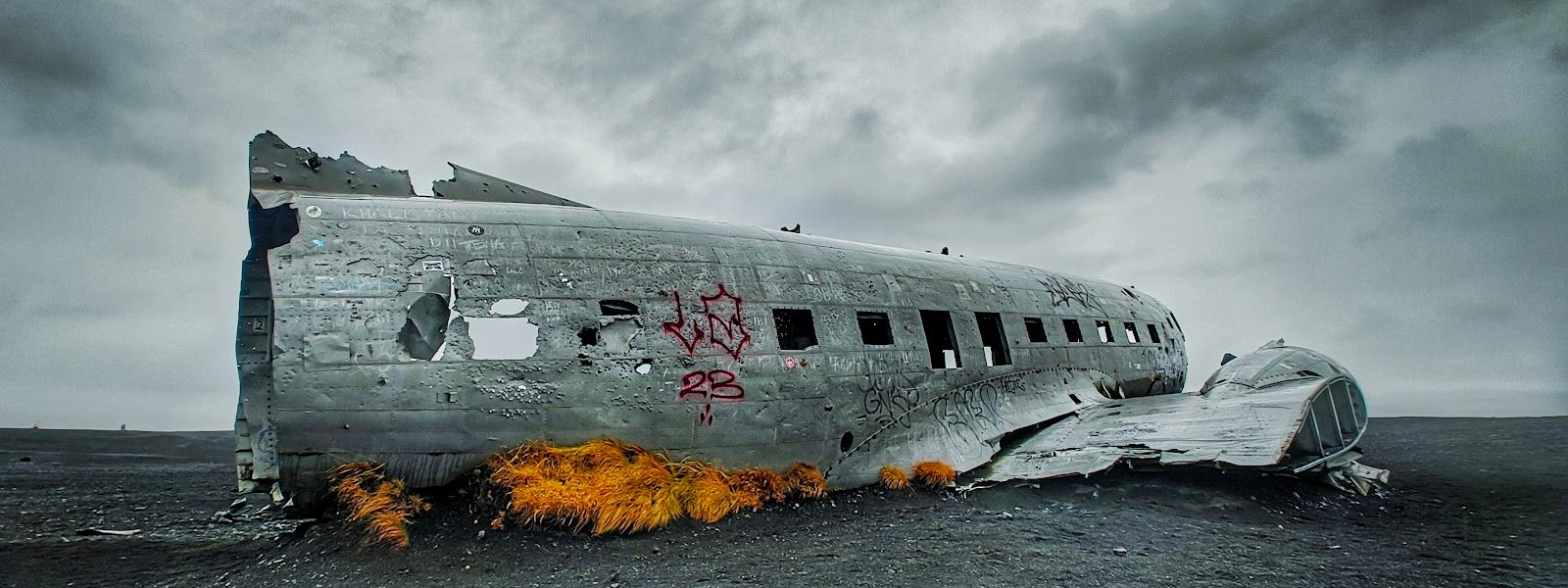
All seven crew walked away from the 1973 crash-landing, and the fuselage has lain on the sand ever since.
- Entrance
- Free — there is no ticket for the site.
- Accessibility
- No wheelchair-accessible entrance. The shuttle is the only alternative to walking the sand track.
- Parking
- Paid gravel car park by the road, about 3.5 km from the wreck.
- Difficulty
- Easy but long: a flat sand track with no climb, 40 to 60 minutes each way.
- Transport
- No public transport: there is no bus stop within 5 km.
- Hours
- Open 24 hours.
- Address
- Sólheimasandur, 871 Iceland
What makes it special
The aircraft is a Douglas C-117D, a US Navy transport flying from Hofn to Keflavik after a supply run to the radar station at Stokksnes. Ice built up about 45 minutes after takeoff and blocked the carburettors, and both engines failed. The pilot turned south for the coast rather than risk the glacier, and the crew landed on a frozen river on the sand. All seven walked away. The aircraft was written off and left in place.
What remains is mostly the fuselage, dented and stripped, marked by decades of graffiti and gunfire. It stands alone on flat black sand with no vegetation and no buildings in sight. The contrast does the work: dark ground, pale metal, open sky.
Film and music crews have used it for years. Justin Bieber shot the video for "I'll Show You" here in 2015, and the song "Gerua" from the Indian film Dilwale was filmed on the wreck, which brought a wave of Indian visitors to the site.
Good to know
- The shuttle is a separate cost. It runs every 30 minutes and charges 2,000 ISK one way, 3,200 ISK return, on top of the paid car park.
- No facilities. There are no toilets, no drinking water and no information point at the car park or at the wreck.
- Dress for wind. The route is open sand from end to end, with nothing to break the wind, and the coast is cold.
- The wind carries the sand. Protect camera gear on windy days and change lenses in the car, not out on the flats.
Getting there
The wreck is a stop on the drive between Reykjavík and Vík, and everyone arrives by car. From the car park a flat track runs across the sand to the coast: 3.5 km each way, 40 to 60 minutes on foot, roughly two hours there and back. There is no climb and no rough ground, only distance. A shuttle covers the same stretch every 30 minutes for anyone who would rather not walk it. The plane stays out of sight for the whole route and appears only in the last 100 metres.
Best time to visit
Better: a weekday, when there is a real chance of a gap between groups at the wreck.
Avoid: setting out when the forecast is bad or the weather is already turning.
This is a photography site above all, and groups take turns posing on and around the fuselage, so a short wait usually buys a clear frame. Bad weather is the other consideration: the sand gives no cover, and the police have advised against the walk when conditions deteriorate.
Sun & daylight
Nearby Places


Similar Places


Featured in our guides
Solheimasandur Plane Wreck on the map
In January 2020 two visitors died of hypothermia near the wreck after being caught in a storm. A month later rescue teams were called out to several people who had walked out despite a police warning about the weather. There is no shelter anywhere on the route. If the weather turns, turn back.
Get directions

Your whole travel map in one place
Get inspired by new places around the world and find the ones worth the journey
Frequently asked questions
How long does it take to walk to the wreck?
It is 3.5 km each way over flat sand, 40 to 60 minutes one way. Allow about two hours there and back, plus time at the plane.Is there a shuttle instead of walking?
Yes. A shuttle runs between the car park and the wreck every 30 minutes. It is charged separately from parking, at 2,000 ISK one way and 3,200 ISK return.Why is there a plane on the sand?
A US Navy Douglas C-117D lost both engines to icing on 21 November 1973 and made a forced landing on Solheimasandur. All seven crew survived, and the aircraft was written off and left where it came down.Are there toilets at the site?
No. There are no toilets at the car park or at the wreck, and no drinking water and no information point either.