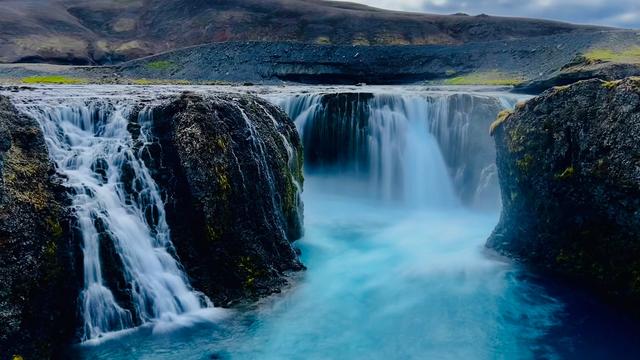
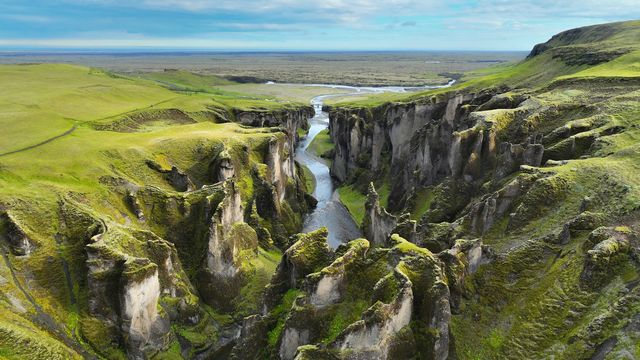
Sigoldugljufur is a canyon in the highlands of South Iceland, reached from the F208 mountain road. Along one wall, water seeps out of the rock and drops in a row of small waterfalls into a turquoise river, with moss covering the rock between them. There is nothing built at the site: a car park off the road, and a walk over old lava to a viewpoint on the rim. It suits people already driving the F-roads in a vehicle rated for them, and it works as the turning point of that drive.
Sigoldugljufur Canyon
Local name: Sigöldugljúfur

The falls come out of the canyon wall itself rather than from a stream above, in numbers too high to count from the viewpoint — hence the nickname Valley of Tears.
- Accessibility
- No wheelchair-accessible parking and no wheelchair-accessible approach; the walk in crosses uneven lava rock.
- Parking
- Two free car parks off F208; the further one is gravel. No charge.
- Difficulty
- An easy walk from the car park to the viewpoint over an old lava field. The surface is uneven black rock. The rim can be followed further for closer views.
- Transport
- No public transport: no bus stop within 5 km.
- Address
- Near F208, 851 Iceland
What makes it special
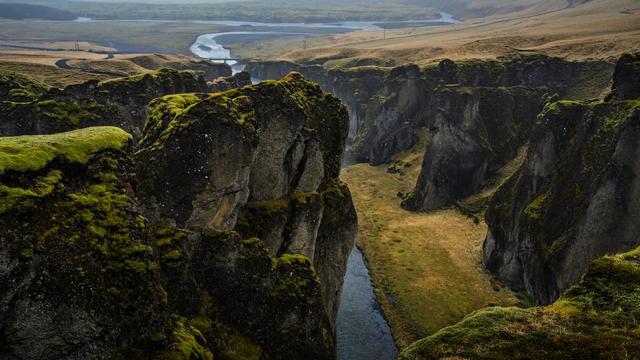
The waterfalls at Sigoldugljufur do not fall from a river above. Water comes straight out of the canyon wall and drops in a long row of separate threads, over rock covered in moss. The river underneath them is turquoise. Those two colours are the reason the canyon is photographed, and they separate best under a clear sky.
The approach hides all of it. The walk in crosses an old lava field of black rock and low moss, flat enough that the canyon reads as an ordinary river in ordinary ground until you are almost at the rim. From the viewpoint the falls line up along one side, close enough to pick out individually. The canyon rim can be followed further for a closer look at them.
Good to know
- Vehicle: the last stretch is F208, a mountain F-road. A car rated for F-roads is needed; the drive is the obstacle here, not the walk.
- Road closures: F208 is not open at all times. When it has been shut, the canyon has still been reached on foot.
- No facilities: there are no toilets, no drinking water and no information board at the canyon or anywhere near it.
- Carrying on: continuing along F208 towards the national park means many kilometres of gravel 4x4 driving. Treat that as a separate day.
Getting there
There is no public transport into this part of the highlands, so everyone arrives by car, and the final stretch is the F208 mountain road. Parking is not at the canyon itself. The nearer lot sits about 860 m away, a second one about 1.5 km out on gravel. From either, the rest is on foot across an old lava field of uneven black rock to the viewpoint on the rim. Nothing gets you closer than the car parks. When F208 has been closed to traffic, people have walked in from further back.
Best time to visit
Better: a clear day, and a weekday rather than a weekend.
Avoid: setting out without first checking whether F208 is open.
The colours are the point of the trip, and the moss and the turquoise water separate best in direct light. On a cloudy weekday the viewpoint can be quiet enough for a slow walk along the rim.
Sun & daylight
Nearby Places

Similar Places

Featured in our guides

Your whole travel map in one place
Get inspired by new places around the world and find the ones worth the journey
Frequently asked questions
Do you need a 4x4 to reach Sigoldugljufur?
Yes. The approach runs along F208, a mountain F-road, and a vehicle rated for F-roads is required. The driving is what stops most people, not the walk at the end.Can you still visit if F208 is closed?
It has been reached on foot with the road shut. Plan that as a hike rather than a short detour, and start with the road status before the day is built around it.Are there toilets or drinking water at the canyon?
No. There are no toilets, no drinking water and no information board anywhere near the site. Carry what you need for the drive as well as for the walk.How many waterfalls are there?
There is no exact count. Dozens of separate falls run in a row along one wall, and from the ground the closest of them blur into each other.