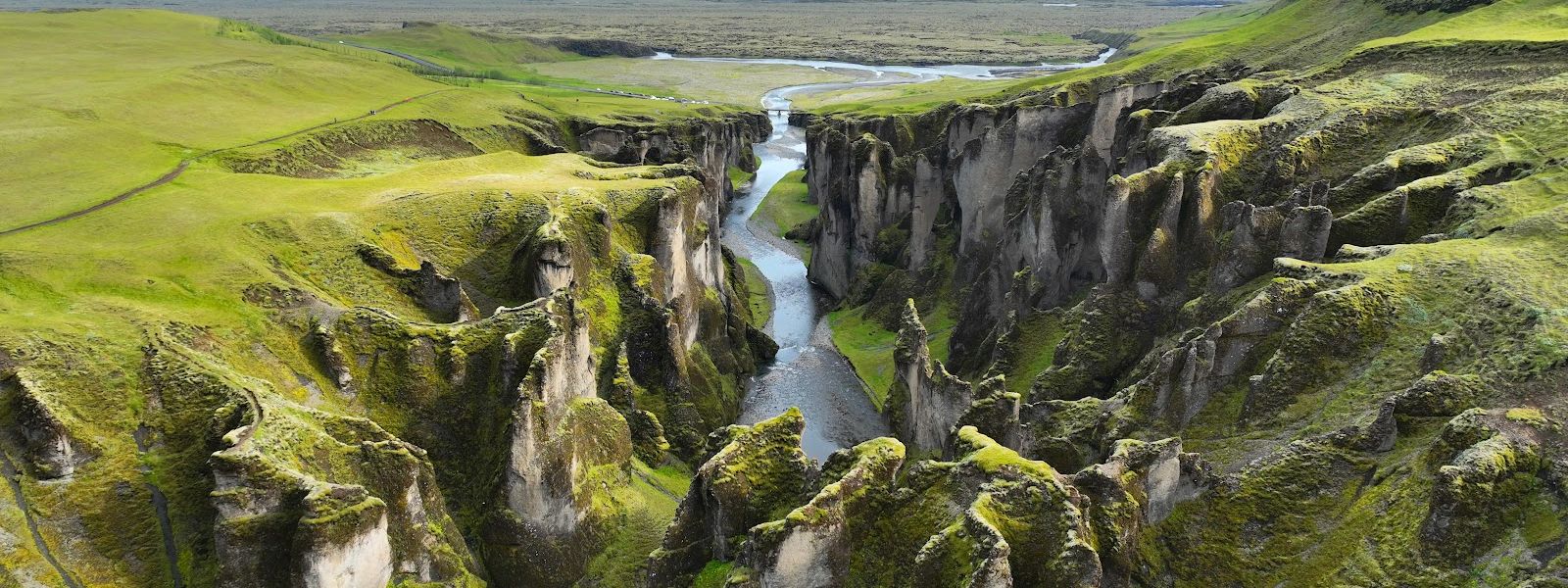
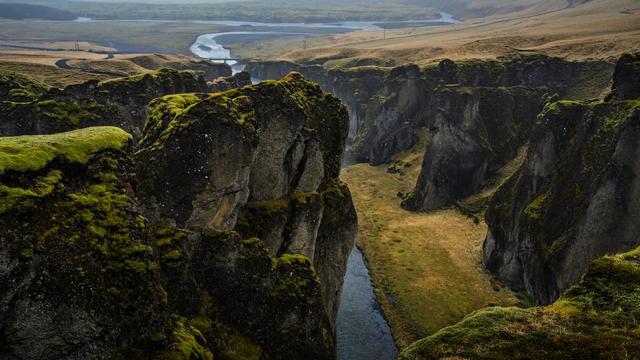
Fjadrargljufur is a canyon in south-east Iceland, near the Ring Road and not far from Kirkjubæjarklaustur. The Fjadra river runs along its floor, between steep walls up to 100 metres high, over a length of about two kilometres. Glacial meltwater cut it through rock and palagonite during the cold periods of the Ice Age, roughly two million years ago. A path follows the eastern rim to a platform facing a waterfall on the western side. A visit is the walk out and back, with views from the lookouts along the way.
Fjadrargljufur Canyon
Local name: Fjaðrárgljúfur
In May 2019 the canyon was closed to visitors: a Justin Bieber music video had drawn more people than the ground could take.
- Entrance
- Free
- Accessibility
- No wheelchair-accessible entrance. The path climbs from the car park.
- Parking
- Paid car park at the trail head, 1,000 ISK as of mid-2026. Toilets, a food truck and a coffee stand on site. A second car park saves walking up the trail.
- Difficulty
- Prepared path, about 20 minutes one way and roughly 2 kilometres out and back. Uphill at the start.
- Transport
- Self-drive (Route 206 off the Ring Road)
- Address
- Route 206, 880 Kirkjubæjarklaustur
What makes it special
The scale registers first. The walls stand up to 100 metres high, and the Fjadra river winds along the floor of a gorge about two kilometres long. The rock is palagonite, cut by glacial meltwater through the cold periods of the Ice Age, roughly two million years ago. A path runs along the eastern rim, with viewpoints stepping out above the bends. The last platform faces a waterfall on the western wall. In late May the woolly fringe moss along the rim is bright green. The canyon also has a screen record: Justin Bieber filmed the video for "I'll Show You" here, and the opening episode of Game of Thrones season 8 used it for the dragon flight.
Good to know
- Toilets and food at the trail head — the car park has toilets, a food truck and a coffee stand.
- Expect company — the canyon is heavily visited, and a viewpoint to yourself is unlikely.
- Stay on the marked path — the canyon was closed to visitors in 2019 after the flow of people began to damage the ground.
- The climb comes first — the path rises from the car park before it follows the rim, and the waterfall view is at the far end.
Getting there
Cars come in off the Ring Road, not far from Kirkjubæjarklaustur, and the trail starts at the car park. Everything after that is on foot: a prepared path climbs the eastern rim to a line of viewpoints and ends at the platform opposite the waterfall. There is a second car park for those who would rather not walk up the trail.
Best time to visit
Better: a clear day in late spring or early summer. In late May the woolly fringe moss on the canyon walls is bright green.
Avoid: low cloud and heavy rain, which take away the long views along the gorge. The walk itself still works in the wet.
The panoramas are what the viewpoints are for, and they need clear air; the moss colour is the reason to time a visit for late spring.
Sun & daylight
Nearby Places


Similar Places


Featured in our guides
Fjadrargljufur Canyon on the map
The walls are steep and drop up to 100 metres. Stay on the marked path and back from the rim, and keep children close at the viewpoints.
Get directions

Your whole travel map in one place
Get inspired by new places around the world and find the ones worth the journey
Frequently asked questions
How long does the walk take?
About 20 minutes one way to the far lookout, roughly 2 kilometres out and back on a prepared path. It climbs at the start.What has been filmed at Fjadrargljufur?
Justin Bieber's video for "I'll Show You", and the first episode of Game of Thrones season 8, in which Jon and Daenerys fly their dragons together.Are there toilets and anywhere to buy food?
Yes. The car park has toilets, and a food truck and coffee stand sell something warm after the walk.How deep is the canyon, and how old?
Up to 100 metres deep and about 2 kilometres long. It dates from the cold periods of the Ice Age, around two million years ago, and was cut by glacial meltwater through rock and palagonite.